Amaravati: An exploitative capitalist project?

"Great cities are like dreams: they contain everything you can imagine, yet even the strangest vision is a puzzle hiding a secret longing or a hidden fear”- A take-off of a passage from Italo Calvino’s 1972 novel, Invisible Cities.
What the above ground to earth observation precisely infers is that : World-class cities resemble dreams in their infinite possibilities. However, every element within them, no matter how surprising, is a puzzle revealing a core human yearning or apprehension.
As environmentalists mourn the passing of ecologist Madhav Gadgil on January 8, the present ecological crises in the Western Ghats, marked by landslides and floods, cast his unheeded 2012 report in a grim new light.
The Kerala government's dismissal of his panel's recommendations as "anti-people" now appears to be a costly error in judgment.
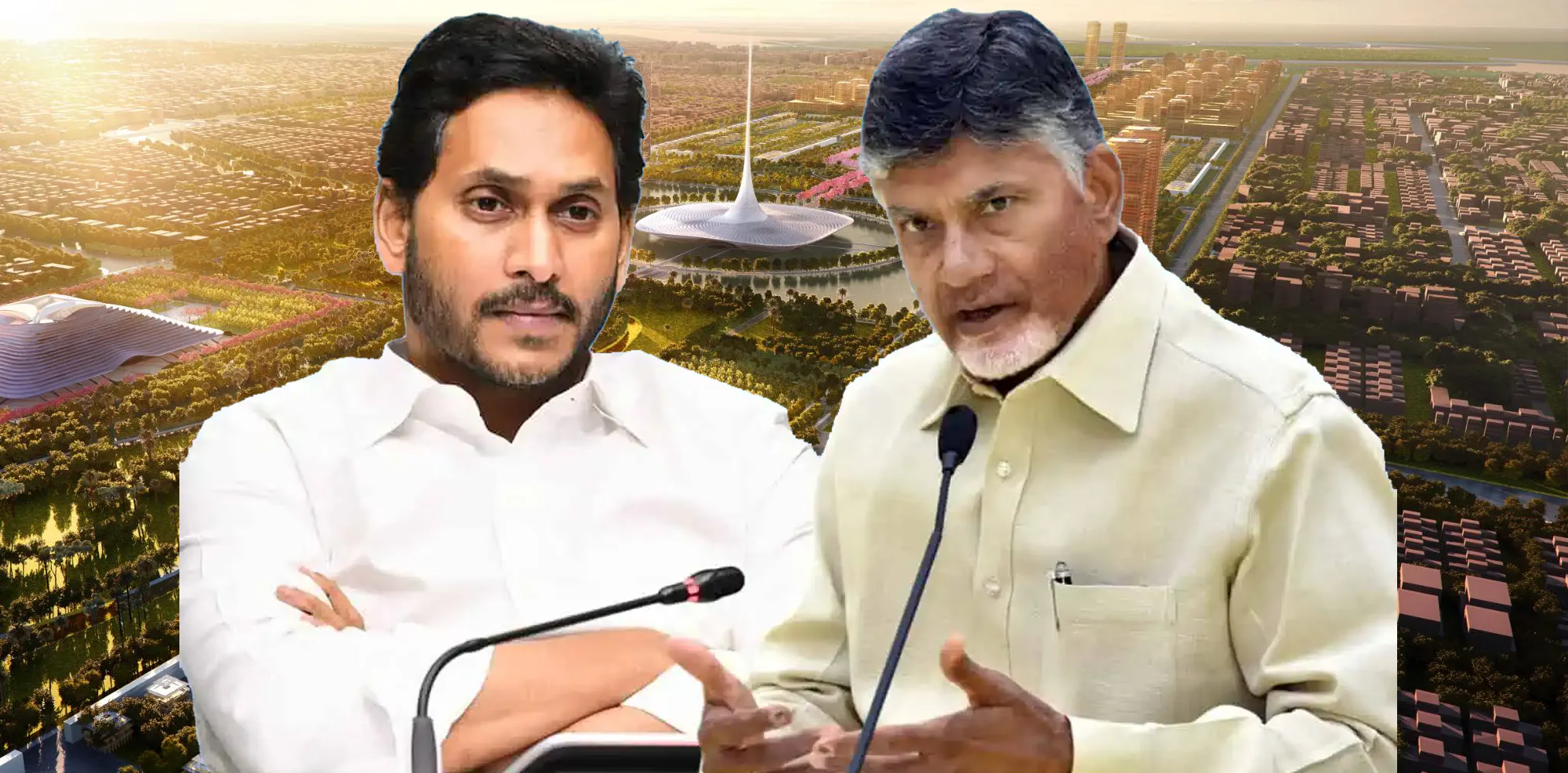
A parallel can be drawn to the controversy(following latest outbursts of YS Jagan) surrounding the new Andhra Pradesh capital, Amaravati, a green field capital being built from scratch with no imposition of prior infrastructure.
While opposition leader YS Jagan's claims that building the new capital city on the Krishna River floodplains is "insane" and financially unviable could be dismissed as political posturing, and a lament of a prejudiced opposition leader, his concerns echo those of numerous environmentalists and expert reports, including Sivaramakrishnan Committee Report, which had found Amaravati “not suitable” for being made into the capital city.
These warnings of experts about significant ecological risks have largely been unheeded since the project began in 2014, raising fears that the Amaravati project could become the next "unheeded warning", mirroring the fate of the Gadgil report.
These reports warn about Flooding Vulnerability, Destruction of Fertile Floodplains, Geological Instability, Loss of Prime Agricultural Land.
These reports reveal that 70% of the proposed capital area is prone to flooding, and how building a capital on the Krishna River’s floodplains disrupt natural absorption and discharge systems, which in turn would significantly increase the risk of flash floods.
On the other hand, experts have cautioned that the region's deep black cotton soil is unstable for large-scale urban structures, necessitating expensive pile foundations and massive land-filling that could displace floodwaters to surrounding villages, while the diversion of over 30,000 acres of highly fertile, multi-crop land for real estate has potential to disrupt local food security and livelihoods.
Much like the Gadgil report, these expert warnings risk becoming a tragic postscript to a preventable disaster if the government continues to prioritize rapid urbanization over ecological resilience.
A decade in, Amaravati is still less a functioning capital than a grand ambition and remains a fantasy being sold to the people. (Regardless of the political discourse that impacted its progress).
As the government launches a second phase of land acquisition and works to secure the city's future through central legislation, mounting debt and political opposition continue to cast doubt on its viability.
The project's immense scale and cost, particularly the acquisition of over 50,000 acres in total, raise serious questions about whether the significant risks will ever yield a sustainable and successful city.
When YS Jagan raised concerns about the "insanity" of building a capital on a river basin, his detractors quickly pointed to cities like London, Paris, Rome, and New Delhi as counterexamples built on river banks, overlooking crucial differences between Amaravati and them.
These cities were developed gradually on naturally elevated ground or required extensive, decades-long engineering works to manage flood risks, rather than being built as a greenfield megaproject in a high-risk floodplain.
These historic cities evolved organically over centuries, without destroying vast tracts of fertile, multi-crop land or forcibly acquiring thousands of acres in a short span.
Amaravati's plan involves massive land-filling and expensive pile foundations due to the unstable black cotton soil, which raises the project costs significantly.
The experts claim that Amaravati's infrastructure costs are four to five times the market rate, triggering suspicions of a scam, highlights a potential for financial impropriety absent in the historical development narratives of the older capitals.
The land pooling in Amaravati also involves complex issues of farmer compensation and legal challenges that are fundamentally different from historical urban growth.
Ultimately, the argument that existing river cities justify the Amaravati project fails to account for the unique, planned, and rapid nature of its construction, which brings its own set of environmental, financial, and ethical challenges.
On the other hand, economists warn that using borrowed funds for recurring expenses or speculative urban projects risks a debt trap, effectively shifting the cost of today’s "fantasy" capital onto the taxpayers of tomorrow.
Some experts view Amaravati as a product of "global financial imagination" where mobile capital prioritizes corporate profit and real estate over equitable urban development and environmental safety.
In a nutshell, beyond the environmental concerns, the heavy financial reliance on debt for Amaravati's construction in a fiscally strained state has the potential to trigger an economic disaster. With a high fiscal deficit and rising public debt, the burden of repaying massive loans may ultimately fall on future governments and the people.
If expert warnings are accurate, Amaravati would represent a profound encroachment on nature and local livelihoods, serving as a stark example of exploitative and greedy capitalist policy.