AP Local Body Polls: Game Over At Nomination
“There is no other single lawless body in the country whose criminal record compares with that of the organized gang known as the Indian Police Force"
This highly critical observation was made by Justice Anand Narain Mulla of the Allahabad High Court in 1961, during a judgment in the case State of Uttar Pradesh v. Mohammad Naim, highlighting systematic issues within the police force at that time.
No matter how stinging this criticism appears, a segment of police officers has historically worked, and continues to work, day and night to justify such a reputation. To see proof of this today, one only needs to look at the unfolding scenario on the local body election stage in the state of Andhra Pradesh.
The breakdown of law and order in the state shows that the late Justice’s 1961 observation about the criminal nature of the police force is no longer just historical criticism. Instead, it seems like a visionary training manual for the current local body polls, or it seems so, given the allegations raised and complaints filed by the opposition party to that effect.
Going by the allegations and complaints filed by the opposition, the situation is a perfect reminder that the great theater of Indian democracy has always evolved. However, the ongoing chaos during the nomination process for the Andhra Pradesh local body elections has introduced a highly efficient shortcut. Why trouble the voter with long queues, scorching heat, and the heavy burden of choosing a candidate when the entire election can be wrapped up easily right at the nomination stage?
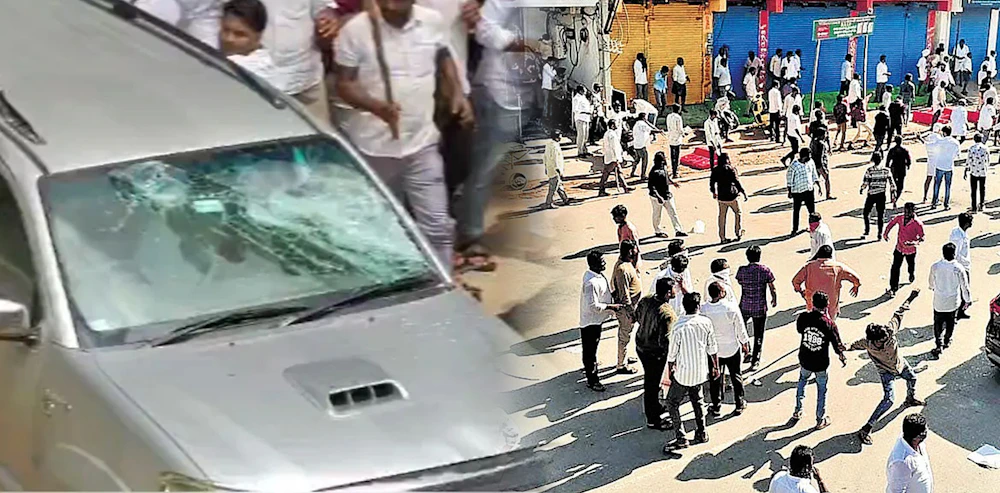
As opposition candidates and their agents found their nomination papers systematically snatched, torn, or magically misplaced, the police force rose to the occasion by standing still and doing absolutely nothing. Even when they did break their silence, such as firing warning shots in the air to disperse violent mobs in Pulivendula or watching opposition convoys get pelted with rocks in Punganur, it was done with the complete detachment of an umpire who has already decided which team is allowed to win.
This silent, watchful protection transforms the state's administration. It makes everyday onlookers wonder whether they are living in a democracy in Andhra Pradesh, or if they have traveled back in time to the lawless political violence of old-school Bihar or West Bengal.
Meanwhile, Deputy Chief Minister Pawan Kalyan provides the necessary dramatic performance for this grand production. The leader who famously and repeatedly roars on television cameras that his government will show "zero tolerance" for threats to peace and security has adjusted his volume perfectly. His loud warnings that anti-social elements will be crushed are delivered with immense passion, but only if those elements belong to the previous ruling party.
When local groups from the current ruling party deploy iron rods and glass bottles to secure a large number of "unopposed victories," his fiery speeches undergo a gentle transformation into strategic silence. It appears that a broken law-and-order situation is only a threat to democracy when it doesn't help your own coalition win seats uncontested.
This local masterpiece unfolds under the quiet, uncaring gaze of the Central government. The Centre’s total silence over the ongoing election violence in AP fits perfectly into the wider national picture.
At a time when the whole country is worried about the bias of the Election Commission, suspicious voter deletions, and the modern art of vote theft, Andhra Pradesh has pioneered a simple alternative to digital manipulation. Why engage in complex, tech-driven rigging or cyber vote theft when you can simply block the opposition from filing a piece of paper? It is an elegant, cheap, and highly physical upgrade to election management.
As the state celebrates these uncontested wins, the thinking public is left with a deep puzzle. We are no longer burdened by the messy, unpredictable rules of a real democracy, nor are we living under a strict military rule. Instead, we have reached a perfect middle ground: a modern election model where winners are declared before a single vote is even cast, protected by a police force that treats law enforcement as a spectator sport.
In a nutshell, the entire spectacle can be summed up by modifying that legendary dialogue from the Deputy CM's own cinematic treasury: “Maku konchem thikkundi... kani polls gelvadaniki oka clear lekkundi' (We have a bit of craziness... but we have a calculated mathematical formula to win the polls). Why wait for a voting machine or a polling booth when victory can be calculated mathematically at the registration desk? It is a flawless political symphony.











Comments (…)
Leave a Comment