CBN-PK: Outdoing Cicero In The Act Of Flattery?
“Sycophancy is the currency of absolute regimes; it requires the systematic murder of one's own memory in exchange for the ruler's favor”
This timeless wisdom by political theorist Hannah Arendt suggests that under a powerful ruler, heavy flattery and competitive praise become the ultimate tools to survive or gain political favors. To successfully pull this off, politicians must purposefully execute a systematic murder of their own past beliefs, promises, and principles, wiping away their memories so they can worship a leader they once aggressively opposed.
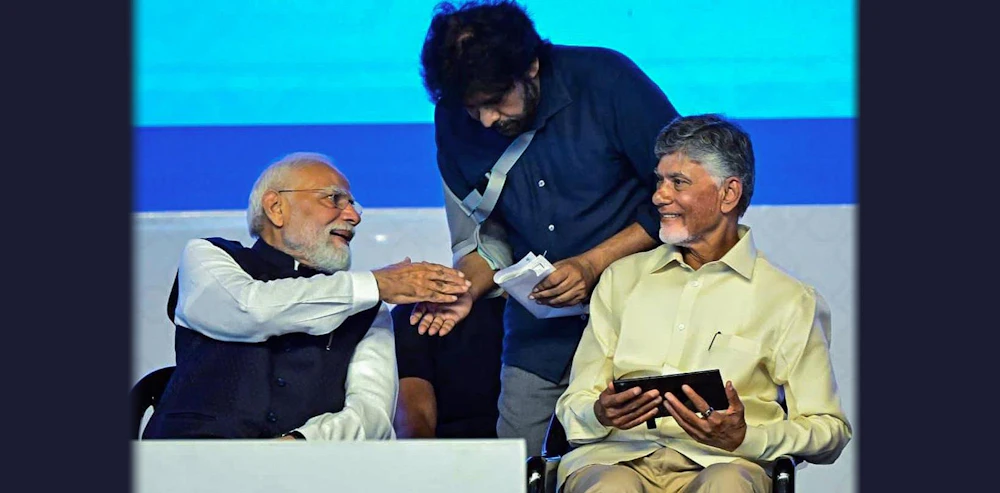
For those discerning onlookers watching the grand inauguration proceedings of the Bhogapuram International Airport, this exact quote would have echoed with deafening relevance. The political spectacle on the tarmac served as a living, breathing case study of Arendt’s thesis, as the leadership of Andhra Pradesh demonstrated a masterclass in trading their historical integrity for immediate political survival.
If Marcus Tullius Cicero, the legendary Roman orator who was once a staunch political rival of Julius Caesar during the Roman Civil War, were alive to witness this display, he would have likely retreated to his grave in utter humiliation. Famous for pioneering the "Caesarian Speeches," the ancient art of aggressively flattering an emperor to ensure political survival after finding oneself on the losing side of a war, Cicero was completely outclassed by the Andhra leadership; one who tirelessly claims himself a global visionary, and the other who once masqueraded as the Che Guevara of modern regional politics.
In short, a "Caesarian Speech" is any golden piece of opportunistic flattery where a politician aggressively worships the boss they secretly despise, just to keep their head attached to their neck.
From a political perspective, the entire proceedings at the event served as a perfect example in this exact brand of opportunistic flip-flopping, with the state leadership suffering from an acute case of collective amnesia regarding their own political past.
The Deputy Chief Minister, whose tear ducts remained stubbornly dry when twenty NEET students committed suicide in despair and when young protesting students were brutally lathi-charged, suddenly found his eyes welling up with profound sorrow on stage. This astonishing fountain of public grief was not poured out for the victims of state apathy, but for the most powerful politician in the country, as he proclaimed how deeply pained he feels whenever the Prime Minister faces criticism.
Critics were left scratching their heads at this selective empathy, struggling to reconcile his newfound devotion with the days when he fiercely targeted the central government's policies himself. This glaring act of duplicity exposes a grim political reality: in the theater of modern opportunism, the tragic deaths and broken bones of ordinary students merit absolute silence, while a scratch on a powerful leader's ego demands a full, tearful standing ovation.
The Chief Minister, who once minced no words in branding the Prime Minister a terrorist and publicly mocked him in the assembly by questioning how a leader who deserted his own wife could possibly run a country, underwent an equally breathtaking ideological mutation.
He actively rallied the crowd to "protect" the Prime Minister's leadership from external detractors, transforming from a fierce regional rebel into a devoted imperial bodyguard. This passionate, turncoat defense left political analysts deeply amused, vividly remembering a time not too long ago when this very leader was leading the charge against Delhi's step-motherly treatment of the state.
It stands as a brilliant monument to shameless opportunism, proving that in politics, yesterday's absolute villain can easily become today's infallible deity, provided the alliance terms are right.
Ultimately, the Bhogapuram event proved that in the theater of modern politics, consistency is a liability and praise is a currency. By transforming a regular infrastructure rollout into an absolute festival of competitive sycophancy, the AP leadership showed that when it comes to keeping your political head safely attached, even Cicero has a lot to learn from Amaravati.
Their dramatic transformation perfectly mirrors the timeless Urdu couplet: “Wo badle aise ki dushman bhi sharmsaar ho jaaye,Hum dhoondte rahe wafa, wo bane sana-khwan-e-shah-e-waqt” (They changed so completely that even their old rivals stand astonished; while the public looked for loyalty to old promises, they chose instead to become the singing flatterers of the ruler of the day).
No doubt, even the local chameleons displaced during the airport's construction must be watching from the sidelines in absolute shame, whispering to themselves: “Alas, even our evolutionary camouflage cannot match the lightning-fast hypocrisy of these opportunists masquerading behind the mask of visionary leadership.”