Has The BJP's Invincibility Shield Finally Cracked?

"A regime that treats every political protest as a coup reveals not its absolute strength, but its absolute fear of accountability."
This contemporary political maxim has found a vivid echo in India today, as the ruling party goes into overdrive to manufacture elaborate conspiracy theories out of ongoing, opposition-led protests.
After roughly 30 months of his "Triple Term" victory lap, India's Supreme Leader is facing a delightfully awkward PR nightmare that is completely melting his carefully manufactured, larger-than-life aura. His publicity machinery spent over a decade building a myth of absolute political bulletproofing. Now, a stubborn, "very embarrassing problem" is showing everyone that the emperor's new clothes are actually just regular, wrinkly politician suits.
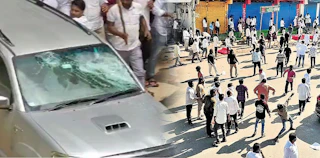
Lately, the Leader, his entire cabinet, and his army of internet trolls have been having a collective panic attack over the opposition's new favorite slogan: "Regime Change." Thanks to the opposition's never-ending protests over alleged "Vote Theft," the government's notoriously fragile ego has taken a massive bruising. Instead of playing it cool, the ruling party is furiously finger-pointing, crying that the opposition isn't just trying to win an election—they are secretly plotting a dramatic, Bangladesh-style coup to overthrow the government through total street chaos.
It’s a beautiful masterclass in political desperation and Olympic-level PR gymnastics to take a standard opposition request to pack up his bags and spin it into a high-budget, foreign-funded international thriller. The state's spin-doctors are working triple shifts to turn everyday political complaints into a blockbuster conspiracy movie. By aggressively hallucinating a fictional threat of total national collapse, they hope the public will be too busy hunting for shadowy, secret foreign "Dhuranadhars" to notice the actual, home-grown citizens standing right outside, stubbornly using their democratic right to voice their grievances.
In manufacturing this wildly dramatic narrative, the Leader and his propaganda army have practically achieved the political equivalent of the proverbial cat that ate a hundred mice and then set off on a holy pilgrimage. The irony is thick enough to cut with a knife. This is, after all, a leader who practically made a sport out of using every unconstitutional trick in the playbook to topple democratically elected state governments across the country. Yet today, he is suddenly sounding incredibly pious, clutching his pearls and weeping about a "conspiracy" to unseat his own regime.
It is truly heartwarming to witness this sudden case of political amnesia, especially when we recall how the Leader originally rode to power by aggressively weaponizing Anna Hazare’s anti-corruption movement to demand a "Regime Change" of his own. The double standard is pure tragicomedy.
Back then, when he was leading the charge to tear down the ruling establishment, it was hailed as a sacred, textbook act of pure democracy. But today, when the current opposition uses the exact same playbook, it is re-branded as a dangerous plot to unleash absolute anarchy. Apparently, a regime change is a beautiful democratic awakening, but only if his party gets to hold the alarm clock.
It is both tragic and deeply entertaining to watch the very leader who famously bragged "Main akhela sab pe bhaari" suddenly look over his shoulder because a few people are standing on a sidewalk. For a man who spent years boasting about his absolute political dominance and iron-fisted control over every state institution, it is a bit of a plot twist to see him treat standard street protests and opposition crowds as an existential threat to his survival.
The public support for these protests, demanding answers about manipulated voter rolls and "fixed" elections, has triggered total panic in the establishment. Instead of doing its actual job and answering basic questions about mysterious voter deletions and bureaucratic lapses, the government has chosen a much easier strategy. They are simply asking the public to ignore the real administrative mess and instead judge the protestors by the terrifying, fictional motive the government invented for them: a sinister, street-led, foreign-funded conspiracy to topple the regime.
By desperately re-branding this legitimate democratic dissent as a terrifying existential threat, the government has accidentally given away the game, exposing their absolute terror at the most basic rule of a democracy: the fact that power can actually change hands. This frantic spin shows that the invincibility shield is officially cracked. Instead of looking like a flawless, unshakable regime, their frantic overreactions have laid bare a very normal, healthy reality that they have spent a decade trying to make people forget—that no political seat lasts forever, and a political transition is still the foundational pillar of the system.
For a ruler who genuinely spent the last campaign trail claiming to be "non-biological" and sent directly by God to steer India toward a utopian "Viksit Bharat" by 2047, this sudden, frantic vocabulary shift is an incredibly bitter pill to swallow.
The panicked language currently echoing from his party ranks betrays a deeply unwelcome realization that has finally pierced the executive bubble: ordinary voters are perfectly willing to trade a divine mandate for actual administrative accountability. By treating routine democratic pushback as an existential crisis, the regime has accidentally admitted what it fears most, that the Indian electorate might just decide to discard the holy prophecy, look past the 2047 PR brochure, and choose a completely different, and perhaps far better, future for the country.
If the regime continues to dig in its heels, this stubborn refusal to politically engage will only fuel the fire, turning a scattered opposition into a unified front with a single, common adversary.
By hysterically crying "regime change" at every turn, the BJP has spectacularly raised the stakes against itself. Instead of shutting down the conversation, they have transformed a simple demand for democratic accountability into a referendum on their own political legitimacy, unintentionally giving a new generation of Indians the ultimate incentive to flex their collective muscle and discover exactly how much power they truly hold.










Comments (…)
Leave a Comment