Nature Doesn’t Take Revenge—It Restores Balance!!
The idea that nature “punishes” humanity is emotionally powerful, but science tells a different story. In 1798, economist Thomas Robert Malthus argued that population could grow faster than food production, eventually triggering famine, disease, conflict and death to restore balance. His theory did not fully predict the advances humanity would make in agriculture, medicine and technology. Yet, centuries later, the bigger question is no longer simply whether nature can feed a growing population—it is whether the planet can withstand the way humans are expanding across it.
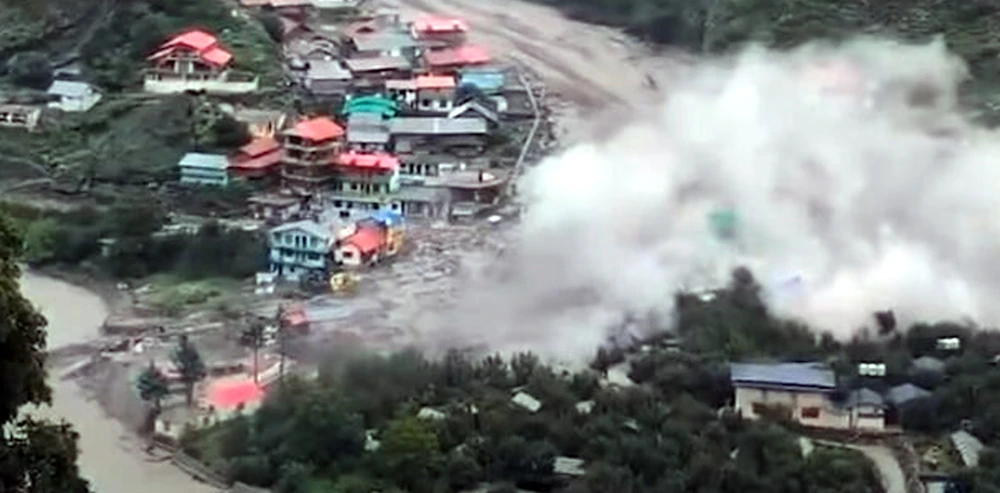
Across the world, places that once had only a few homes now have entire towns, resorts and roads. Hills are cut open for highways, forests are cleared for construction, streams are surrounded by buildings, and floodplains are turned into housing projects. Tourism brings thousands of visitors to once-remote locations, while vehicles, concrete and infrastructure continue to multiply. But the basic geography remains unchanged. The hill is still the hill, the river is still the river and the stream still needs its natural path. Nature’s capacity does not automatically expand just because human demands do.
This is where disasters become far more complicated. Heavy rain, landslides, floods, droughts and cyclones are not new phenomena. What has changed dramatically is the number of people and the amount of property exposed to them. Humans weaken slopes by cutting hills, block natural drainage channels, occupy river floodplains and remove forests that help regulate water. When extreme weather arrives, the consequences can therefore become catastrophic. We call it a “natural disaster,” but the scale of the destruction is often shaped by human decisions made long before the rain or storm arrives.
Nature, however, has no anger or desire for revenge. It does not decide who deserves punishment. It simply follows physical laws. Destroy forests and the water cycle changes. Block waterways and flood risks rise. Destabilise hills and landslides become more likely. Alter rivers and their natural flood zones, and flooding can become more destructive. A warming climate can also influence the intensity and frequency of certain extreme weather events. What looks like nature “fighting back” is often the planet responding to pressures humans themselves have created.
History offers another warning. Great civilisations have risen, built enormous cities, accumulated wealth and assumed their power would last forever. Yet many eventually weakened through war, disease, economic stress, environmental changes, resource pressures or internal instability. It would be wrong to claim that nature destroyed every fallen civilisation. But history repeatedly shows that when a system exceeds its limits, the pressures created within that system can eventually threaten its survival. The same principle applies to cities, economies, societies and ecosystems.
That gives Malthus’s old argument a new meaning. The modern question is not merely, “How will nature feed so many people?” It is, “How long can humans continue building a world that remains capable of supporting so many people?” Population is only one part of the equation. Consumption, construction and human ambition matter just as much. If every hill becomes a road, every stream becomes real estate, every forest becomes a construction site and every river is treated merely as a resource, the consequences will eventually arrive. Sometimes they come suddenly as floods, landslides, droughts or heatwaves; sometimes slowly through falling groundwater, soil degradation, biodiversity loss and climate change.
Nature, then, does not need revenge. It does not need to “punish” humanity. We create pressures within a natural system, and eventually face the consequences of those pressures. Civilisations have disappeared before, and ours is not automatically exempt. The real danger is not simply that humanity is growing—it is that our sense of entitlement and expansion is growing faster than our respect for natural limits. Nature is not the threat. The dangerous gamble is believing that we can endlessly push nature beyond its limits without paying the price.














Comments (…)
Leave a Comment