NEET Protest And A Not-SO-Neat Response
“Elections bestow the right to rule, but public dissent reveals the virtue of the ruler.”
In other words, the above axiom suggests that while elections determine who shall hold the mandate of governance, it is public dissent that evaluates the true quality of their administration. Simply put, winning an election gives a regime the keys to the kingdom, but public outrage delivers the actual performance review.
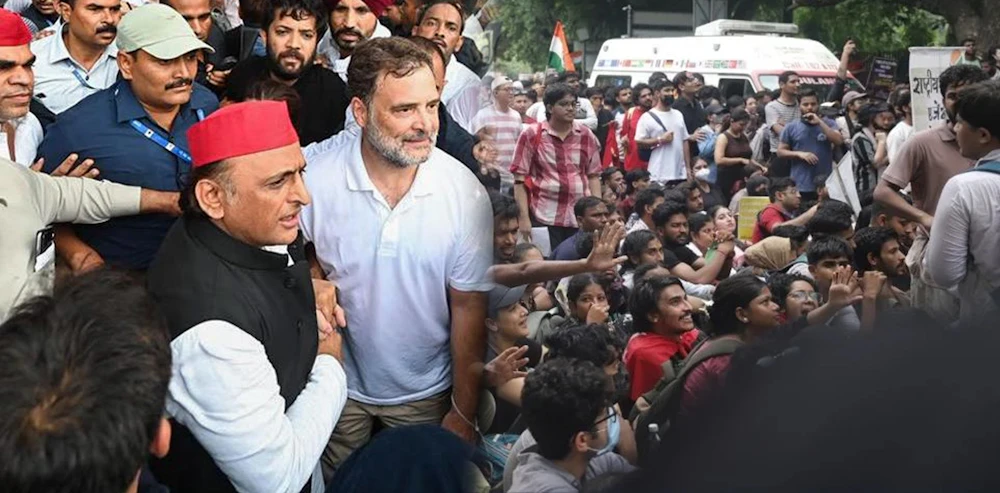
For a slice of the above wisdom’s pie, look no further than the 'March to Parliament' by some frustrated youth, or, as the ruling party would call them, 'cockroaches', and the opposition's circus outside the Prime Minister’s residence, labeled by the regime as an opportunistic, confrontationist, 'grave security threat.'
Yet, rather than reading the room, the government is doing what it does best: unleashing its propaganda machinery across electronic media, social networks, IT cells, and WhatsApp warrior groups to spin wild conspiracy theories and distract everyone from how badly they blew it. This stubborn behavior clearly shows that the government simply does not understand, or care about, public anger. A sudden surge of public anger like the one at Jantar Mantar would force any ordinary political party to stop and think. For the BJP, it is simply business as usual.
While government spokespersons openly branded the protesters as a 'B-team of terrorists' bent on tearing the country apart, the online IT cells and WhatsApp warrior groups rolled out a much wilder script. According to their internet-certified logic, the entire protest is a massive foreign plot to crush India's role in the U.S.-led 'Pax Silica' coalition. In this grand narrative, the unrest is meticulously timed to fuel political instability right before the UP elections, serving as a coordinated Chinese scheme to freeze India’s lithium mining and protect Beijing's monopoly over the global AI market.
This political strategy follows a strict pattern. Long before a local movement can even explain its demands, the propaganda machinery steps in to kill it off. It transforms real, complex human struggles into simple, manufactured threats to national security.
Let's accept the fact: this outrage erupted because the government completely botched the NEET exam. Even the Supreme Leader had to validate this reality. After keeping a long, tight-lipped silence, he finally scrambled to tell the public that paper leaks are a 'great sin', a spiritual awakening that mysteriously happened only after he felt the heat of public anger and found himself pushed into a corner. This confession exposes the truth: the protests are not driven by imaginary conspiracies, but by the government's own failure to solve the problem when it had the chance.
Conspiracy theories cannot cover up administrative failure. The students' demands for honest exams and a responsible education minister are completely legitimate. Had the establishment acted right away instead of waiting until the Supreme Leader lost control of the narrative, the entire crisis, including the opposition’s dramatic circus before his residence, would never have happened.
Those who plot conspiracies spend next to nothing exploiting the conditions handed to them. Until the government learns that taking their bait is far more expensive than exercising restraint, these plotters will continue to achieve massive results.
The protest is a clear sign of growing youth desperation. Young Indians are breaking under rising prices, underemployment, failing social services, and an electoral process that feels heavily rigged. This regression is happening under the comprehensive control of the state. Yet, the ruling regime remains happy to dodge responsibility by painting every domestic crisis as a manufactured anti-national conspiracy. Never before has a government done so much to solidify its authority while entirely uncementing out its accountability.
Today's youth are done with conspiracy theories; they demand less political theater and more real-world solutions. They want a mature, collaborative leadership that is fitting for a country of this stature. Otherwise, the public will respond with the same hostile politics, searching for a leader to challenge the entire establishment.
They are already willing to accept being labeled "cockroaches" and "anti-nationals" just to force a total break from the status quo. The government must stop diverting the crisis with manufactured plots. Instead, it needs to acknowledge public anger, promise a conciliatory effort to correct its failures, and allow genuine governance to win back the trust of all citizens.
















Comments (…)
Leave a Comment