Ramayana: Soul Lost in Pixels
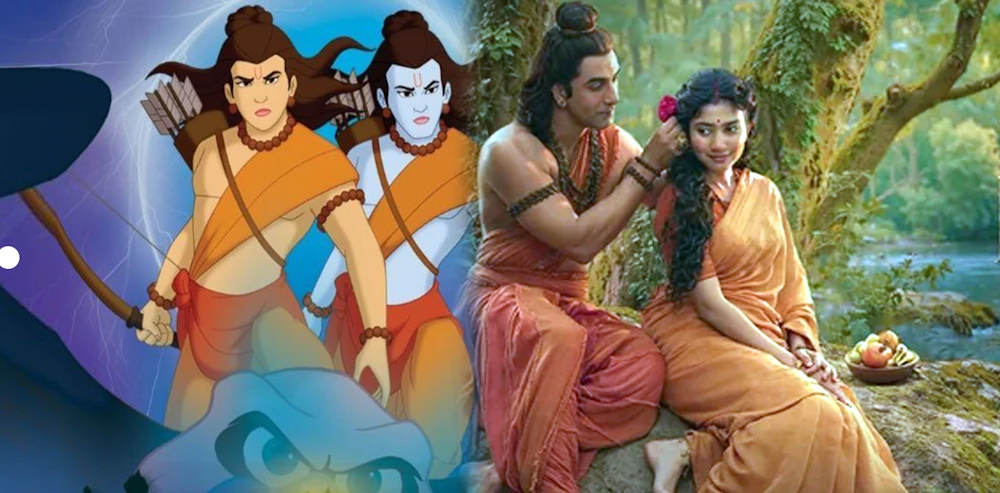
“వినుడు వినుడు రామయణ గాధ వినుడీ మనసారా / వినుడు వినుడు రామయణ గాధ వినుడీ మనసారా / ఆలపించినా ఆలకించినా ఆనందమొలికించే గాధ / వినుడు వినుడు రామయణ గాధ వినుడీ మనసారా” ("Listen, oh listen to the story of Ramayana, listen with all your heart / Whether you sing it or listen to it, this is a tale that showers pure bliss")
The absolute perfection of these opening lines of a classic song from Lava Kusa (1963) beautifully sums up how an epic like the Ramayana should be narrated on screen. In the golden era of Telugu cinema, two young boys could sit on a bare studio floor, strum a simple stringed instrument, and move millions to tears of spirituality without a single pixel of green screen in sight.
They proved that the epic relies entirely on the sacred weight of its language and the raw emotional depth of its performers. It was an era where the narrative carried itself, demanding nothing more than structural reverence, immaculate diction, and actors who genuinely looked like they had descended from the heavens, rather than stepped out of a vanity van or been salvaged through de-aging Photoshop.
This pure, unadulterated piety was the standard for Telugu classics, spanning masterpieces like Lava Kusa, Sampoorna Ramayanam (1971), and Sitarama Kalyanam (1961). Whether captured in the stark dignity of black-and-white or the vibrant hues of early Geva Color, these films treated the epic not as a commercial product, but as a spiritual experience.
When Sr. NTR, whose iconic portrayals of Lord Rama and Lord Krishna found a permanent place in the pooja rooms of every Telugu household, or, Shobhan Babu, famously titled ‘Andhra Andagadu’, stepped onto the screen, their commanding dialogue delivery and theatrical poise radiated actual divinity, making the cardboard sets and painted backdrops completely disappear.
The filmmakers possessed a profound understanding that the Ramayana is an emotion deeply rooted in bhakti (devotion). The simplicity of their practical effects, a glowing arrow or a cardboard chariot, only amplified the purity of the narrative, proving that when the storytelling is soulful, the audience's imagination does the rest.
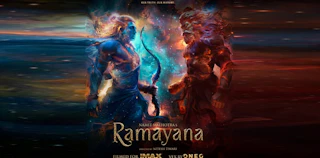
Then arrived Nitesh Tiwari’s astronomical, multi-crore spectacle, Ramayana: Part 1, which apparently operates on the theory that if you throw enough money at a green screen, dharma will automatically manifest. Instead of a sacred chronicle, the modern era has essentially served up a high-budget, Marvel-style superhero movie masquerading as a myth.
Ranbir Kapoor's Lord Rama, wearing the expression of a backbencher suddenly upgraded to top ranker, frequently radiates the existential exhaustion of a modern protagonist who wandered out of a sci-fi franchise. It takes an army of digital artists, derivative backdrops, extra-large animals, and action scenes filled with Hollywood-imported ogres just to give him a faintly holy aura. Meanwhile, the dialogue delivery, which used to be a masterclass in grand, rhythmic prose that shook the soul, has been thoroughly streamlined into casual, globally palatable speech patterns that feel more like a sanitized corporate presentation than divine poetry.
The modern upgrade treats the rest of the epic with the exact same pixel-heavy philosophy, transforming ancient spiritual royalty into a playground for CGI flexes. Where the old classics gave us a Ravana—brilliantly directed by NTR himself in Sitarama Kalyanam, who commanded terror through sheer theatrical posture and a booming laugh, the modern version bets the house on Yash, hoping his roaring star presence can survive an avalanche of Hollywood-grade DNEG visual effects and an operatic Hans Zimmer score.
The narrative is reduced to a series of green-screen action set-pieces, turning the sacred text into a sequence of VFX glitches where everything looks flawless but feels completely empty. By the time the film reaches its heavy CGI fight scenes, it becomes blindingly obvious that while the 1963 classic needed only a simple melody, and the 1971 masterpiece needed only Bapu’s poetic art on canvas alongside the charming performances of its leads, to capture the entire soul of the epic, the modern era requires half the world's computer processing power just to remind us that it’s supposed to be a holy story.
In a nutshell, the sharpest irony of this multi-crore spectacle lies in its reception among the very ideological camp that has spent decades turning the Ramayana into a political battering ram.
In an era where the epic is routinely weaponized by Hindutva proponents as the ultimate symbol of cultural assertion, one might have expected a ₹4,000-crore, globally mounted retelling to become their crowning cinematic triumph.
Yet, the film’s sterile, Westernized packaging, complete with A.R. Rahman’s score, Ranbir Kapoor’s resurrected "beef-eating" controversies, endless online hand-wringing over whether Sai Pallavi is the "right fit" for Sita, and an obsession with pleasing Western IMAX audiences over traditional sensibilities, left even the most hardcore ideological purists cold and conflicted.
Having stripped the sacred text of its organic bhakti to chase Hollywood-style box-office validation, the makers ended up in a comical no-man's-land: too sanitized and derivative to move the genuine devotee, and far too "unauthentic" to rally the political faithful.












Comments (…)
Leave a Comment